
New funding flexibility under the 2026 reforms opens the door to growth. Whether building societies walk through it will depend on how well they combine digital convenience, trusted advice and genuine member engagement. Key takeaways The Building Societies Act 1986 (Assimilation to Company Law and Changes to Funding Limit) Order 2026 changes how certain Bank
By the time Generation Alpha walks through your door, digitally or otherwise, the question will not be whether you are ready for them. It will be whether you are still relevant in their world at all.
Generation Alpha, born from 2010 onwards with the eldest now approaching 16, will begin opening adult bank accounts from 2028. The customer relationships that banks, building societies, and credit unions build with this generation over the next three years will determine deposit growth and institutional relevance for decades to come. The expectations they bring will be unlike anything the sector has encountered before.
“The future of finance belongs to those who listen, evolve and build with this generation, not just for them.”
— Bunita Sawhney, Chief Consumer Product Officer, Mastercard
Who Is Generation Alpha and Why Do They Matter Now?
Generation Alpha is the first cohort born entirely in the smartphone era. They are the children of Millennials, raised by parents who normalised digital banking and app-first services. The bar they carry into financial services has been set by their parents and raised considerably higher by the technology they have grown up with.
They are already the largest generation in history at 2 billion people, and already economically active: 78% have earned money in the past year, with 43% using technology to do so (Visa, 2023). Mastercard data (2025) shows that in Asia-Pacific, 94% of Generation Alpha children already hold a financial account of some kind. This is not a future customer segment. It is emerging right now.
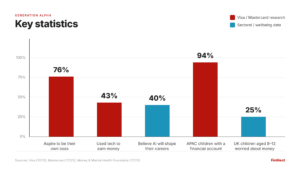
Figure 1: Generation Alpha — Key Statistics. Sources: Visa (2023); Mastercard (2025); Money & Mental Health Foundation (2025).
What Generation Alpha Expects From Banking
For this generation, technology is not a tool they pick up and put down. It is ambient, adaptive, and conversational. When it fails to be these things they notice immediately, then move on.
Conversation, not navigation
Generation Alpha ask questions to their voice assistants the way previous generations asked their parents. A banking app that requires menu navigation to find an answer is not merely inconvenient, it signals that an institution is still in the past. AppsAnywhere research (October 2025), surveying Generation Alpha aged 13–15, confirmed that AI-enabled, adaptive experiences are their baseline expectation across every domain. Financial services will not be exempt.
Personalisation as standard, not premium
Generation Alpha has been algorithmically curated since birth. The notion that a bank would offer them the same product or interface as every other customer will register as negligence. They expect their bank to know their goals, habits, and ambitions, and respond back to them in real time.
Financial guidance, not just financial tools
The Money and Mental Health Foundation (2025) found that 1 in 4 UK children aged 8–13 already worry about money. They do not want a bank that merely holds their money. They want one that helps them understand and build with it. Proactive, plain-language, AI-driven guidance is not a differentiating feature for this cohort. It is the entry requirement.
Purpose and trust, not just products
Generation Alpha will evaluate their bank the way they evaluate every brand – through authenticity, transparency, and demonstrated values. J.D. Power (2025) found 31% of credit union members under 40 would likely leave over unexpected fees. That intolerance will only intensify. Institutions that communicate in opaque language or appear indifferent to financial wellbeing will not earn a second chance.
“Gen Alpha anticipates that technology will continuously learn and evolve with them. Their digital tools should get smarter, more efficient, and more helpful the more they are used.”
— FutureProof.work, January 2026
The Window Is Narrower Than You Think
There is a temptation, particularly in smaller institutions, to treat Generation Alpha as a next-decade problem. It is not. The relationships that will determine whether a teenager opens their first account with you are being formed through their parents’ experiences right now. A poor digital experience today is a missed customer or member in 2028.
2028 when Generation Alpha begins opening accounts at scale
2bn projected generation size — already the largest in history (McCrindle, 2024)
Challenger banks are not waiting. Monzo, Starling, and Revolut are already shaping Generation Alpha’s expectations through their parents’ daily use. By the time a smaller institution begins its programme, those expectations will have been set elsewhere.
The question is not whether you can compete feature for feature. It is whether you can offer something Challengers cannot: genuine community, trusted relationships, and the personalised experience that makes a smaller institution feel like it actually knows you.
What Smaller Banks, Building Societies and Credit Unions Must Do Now
This is not a call to undertake wholesale transformation overnight. It is a call to start the right programmes now, at a sustainable pace. The institutions that win Generation Alpha will not necessarily be the biggest but they will be the ones that listened and took action early enough.
Start the conversation – literally
Even a basic AI-powered chat or voice feature begins the shift toward the interface Generation Alpha expects. No large language model required, just the right fintech partnership. The barriers are lower than ever: fintech providers reporting no obstacles working with credit unions surged nearly fivefold in a single year (America’s Credit Unions, March 2026).
Build financial education into the product
Youth-focused tools, such as savings trackers, goal-setters and financial literacy modules, build relationships with young customers and their parents simultaneously. An institution that helps a twelve-year-old understand compound interest will likely hold their ISA at twenty-five.
Listen to their voices now
The oldest Generation Alpha members are already teenagers with clear opinions. Junior advisory panels and co-design sessions with 13–16 year olds are the earliest and cheapest form of market research for the most important cohort in your institution’s medium-term future.
Make wellbeing structural
Generation Alpha will not just expect a bank that works. They will expect one that cares. Proactive wellbeing nudges, plain-language communications, and visible ethical commitments are the price of entry for this cohort.
You do not need to solve for Generation Alpha tomorrow. But you do need to start today. The cost of beginning now is a fraction of the cost of rebuilding relevance in 2032, when the window will have already closed.
The Reckoning Is Coming. Start Now.
Generation Alpha will arrive with high expectations and make their choices quickly. The institutions that earn their trust will build customer relationships that compound in value for decades. Those that wait will find the cost of inaction, both commercially and reputationally, may already be beyond recovery.
For larger banks, this is a strategic risk. For building societies and credit unions, where long-term member relationships are the entire value proposition, it is an existential one. The technology exists. The partnerships are available. The research is unambiguous.
“The need for such transformation is urgent. The first of Generation Alpha will join the workforce in just four years.”
— STX Next / Visa Research, 2025