

By the time Generation Alpha walks through your door, digitally or otherwise, the question will not be whether you are ready for them. It will be whether you are still relevant in their world at all. Generation Alpha, born from 2010 onwards with the eldest now approaching 16, will begin opening adult bank accounts from 2028. The customer relationships that banks, building societies, and credit unions build with this
How mutuals stay themselves as the savings market automates
Building societies have spent a century and a half earning savers’ trust face to face. A growing share of savings decisions now runs through comparison engines and deposit platforms that cannot see any of it. What comes next will not see it either. This article outlines what this means for the funding book, and gives you the four questions you need to put to your technology partners.
By Kevin Phillips
Last Monday, while the savings industry was finalising its Savings Week campaigns, Anthropic shipped Claude for Financial Advisors, with connectors into BlackRock, Addepar, Orion and a dozen other wealth platforms. OpenAI launched an equivalent for investment bankers days earlier.
Neither touches retail savings. Neither is pitched at your members. They matter anyway, because they show that the plumbing is now in place for software to read financial product data, compare it and prepare action on it, with the human role shrinking to approval.
Cash deposits are likely next. Your society has been supplying its rates to Moneyfacts and the comparison sites for decades, and they have been structuring that data for machines ever since. The next step is direct into the accounts. Personalising the best buy into the “best buy for you” is only a matter of time, so getting access to the member’s account data to then suggest the next best action is the natural step forward.
The market is already moving
Flagstone, one of the largest UK cash deposit platforms, closed 2025 with £18.8 billion under administration, up 21% in a year, on revenue 358% higher than three years earlier. By mid-2026 it was offering access to more than 65 deposit-takers across over 450 accounts. Direct SME deposits rose 81% in twelve months.
Set against a £496 billion mutual deposit base, that is still modest. The absolute figures are the less interesting half of the story. What matters is the behaviour of the marginal pound.
Delegation is replacing switching
The FCA’s 2020 work on a single easy access rate found that only around one in ten easy-access and cash ISA customers had switched in three years, and that accounts opened more than five years earlier paid 0.42 percentage points less than new ones. In cash ISAs the gap was 0.55 points.
That inertia was a line in the funding model. It is what allowed nine of the largest providers to pass through only 28% of base rate rises to easy-access balances between January 2022 and May 2023, against 51% on notice and fixed-term products.
Deposit platforms strip most of the cost of attention out of the decision. Platform customers are barely switchers at all. They made one decision, years ago, and every rate comparison since has been done for them. A large part of the UK deposit market rests on the assumption that most money stays put. That assumption was built for savers who had to do the work themselves.
Why the FSCS increase sharpens the problem
On 1 December 2025 the deposit protection limit rose from £85,000 to £120,000. The intuitive reading is that fewer savers now need to split balances across licences, so the platforms lose one reason to exist.
The opposite is true. Compliance-driven splitting was always the low-margin, defensive use case. Strip it out and what remains is yield optimisation, which is more rate-aggressive, more frequent and less loyal. A larger protected envelope lets a saver chase the best rate with a bigger single ticket.
The strategic point in one sentence:
The question is no longer whether an algorithm will see your rate card. It is whether, when it does, it can see anything about you other than your rate.
From attention to legibility
A society’s advantage has always been carried in unstructured form. A branch manager who knows the family. A community fund. Lending into the streets around the head office. Building societies and mutual-owned banks run around 1,300 branches, 30% of the UK network, and hold 47% of all cash ISA balances on 23% of retail deposits. Members reward the model when they can perceive it.
An algorithm perceives none of it. To a routing engine comparing a 4.35% bond from a 150-year-old mutual against a 4.36% bond from a three-year-old challenger, the mutual is simply the lesser product.
In April 2026 the FCA published its open finance roadmap, setting out how consent-based data sharing extends beyond payments into savings, mortgages and pensions, with a discussion paper on the first scheme due in Q4 2026. The regulator frames open finance as the foundation for agentic AI. The fields that will travel on those rails are being specified right now.
The mutual difference has to become a data field, or it ceases to exist in the channel where a growing share of deposits will be won.
Four questions for your technology partners
None of this requires a new core ledger. The work sits in the digital engagement layer, which is often supplied by a partner. Even if it is your own, you still need to ask the question.
1. Can we throttle product visibility by channel, in real time?
A competitive bond meant for 4,000 loyal members, indexed and published to a national audience, can absorb its entire tranche before the treasury meeting ends. Ask for channel-level ring-fencing with an automatic cut-off when a tranche fills. Fintilect have provided this for years, and on our own engagement platform a tranche closes itself the moment it is full. The distinction that matters is between a throttle and an alert.
“A manual throttle is just a faster way of learning you are already over-subscribed. If a treasury team is watching a dashboard to decide when to pull a product, the decision has already been made for them.”
Kevin Phillips, Fintilect
2. Can we run two speeds of onboarding without running two systems?
A member in a market town branch wants to be treated as a person. An aggregator wants an API response measured in seconds and straight-through processing. Ask for a bi-modal layer that keeps the relational journey intact alongside a gateway which ingests pre-verified KYC, opens and funds the account with no manual intervention from branch staff.
3. Can our APIs carry our purpose, not just our price?
An agent can guess at mutual status from a name it recognises. It cannot filter on lending concentration, branch commitment or community reinvestment, because none of those are fields in any feed it reads. Ask for extensible metadata on every product feed: mutual status, ownership model, lending concentration, branch commitment. Govern those fields to the same standard as the rate itself, because under the Consumer Duty that is exactly what they are.
4. Can we tell a member from a machine in our own reporting?
If aggregator-sourced, direct digital and branch deposits all land in the same bucket, stable funding can be replaced by rate-sensitive money in retail clothing without anyone seeing it until a repricing event. Ask for channel provenance on every balance, flowing through to liquidity modelling and pricing analytics. It is unglamorous and it is the prerequisite for everything above.
The dual-speed balance sheet
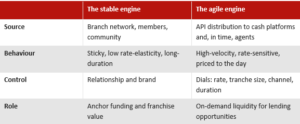
The branch network is what makes the second engine safe to run. A society with genuinely stable core funding can take volatile money deliberately, in controlled tranches, because it does not depend on it. The volatility is absorbed in the middleware and never reaches the high street.
A regional society can lift an API rate on a Thursday, take a defined tranche over a weekend, close the valve on Monday and lend against it. Geography stops constraining funding while remaining a genuine differentiator in lending.
Before the next Savings Week
- Instrument the book. Channel provenance on every deposit. You cannot manage rate sensitivity you cannot see.
- Audit the product data model. If mutual status is not a publishable attribute, that is the gap.
- Test the throttle. Time how long it takes today to pull a product from one channel and leave it live in another.
- Engage the open finance process. Schema decisions made in the next eighteen months determine what an agent can see about a mutual for the following decade. The BSA is the obvious vehicle.
- Reprice the inertia assumption. Model the back book on the basis that automation removes half your remaining stickiness within five years.
UK Savings Week exists because millions of people in this country have little or nothing to fall back on. The institutions best placed to serve them are the ones that stay commercially strong enough to keep doing it, and that now depends in part on being visible to the machines deciding where everyone else’s money goes.
Indifference to the algorithmic savings market is a far greater threat to the building society movement than the market itself. Mutuals spent 150 years making themselves legible to their members. The task now is to make themselves legible to their members’ choice of AI as well.
About the author
Kevin Phillips has over 30 years’ experience gained within the financial services market. Kevin leads the operations of Fintilect’s digital banking engagement teams, from client delivery and success to strategic product initiatives.