

How mutuals stay themselves as the savings market automates Building societies have spent a century and a half earning savers’ trust face to face. A growing share of savings decisions now runs through comparison engines and deposit platforms that cannot see any of it. What comes next will not see it either. This article
UK Savings Week ran from 21 to 27 September and deserved every bit of attention it got. But research by a challenger bank found £126 billion of small business, start-up, club and charity cash sitting in accounts paying no interest at all.
A founder who closed a seed round in March is sitting on eighteen months of runway in a business current account and has not yet been asked by anyone what it is earning. A volunteer treasurer is working out whether the cricket club can afford to re-turf the square. A charity finance officer is moving a restricted grant between accounts, so it is not accidentally spent on salaries.
All three are savers, and all three are short of time to act on it.
UK Savings Week does an important job. The Building Societies Association built it to help people who need it most, with around fourteen million people in the UK having less than £100 to fall back on, and it rightly speaks to individuals. Small businesses, charities, clubs and start-ups have savings questions of their own, and they tend to be harder to answer because the person responsible rarely has a treasury background or much time. That is the focus of this piece.
Businesses borrow at 6.61 per cent and save at 1.97 per cent
The numbers are the Bank of England’s, not ours. In its July release, published on 1 September, the effective rate on UK companies’ stock of sight deposits was 1.97 per cent, while new time deposits from the same firms paid 3.47 per cent. The same release puts the effective rate on new bank loans to SMEs at 6.61 per cent.
A small organisation therefore borrows at well over six per cent while being paid under two on the cash it leaves where it is. Closing that gap needs no new product and no additional risk. It needs a decision about where the balance sits, made by someone who has time to make it.
That someone rarely exists. Corporate treasurers move cash because moving cash is their job. A club treasurer, a charity finance officer, an owner-director or a founder with a product to ship has roughly forty other jobs, and the ninety minutes it would take never arrives.
The direction of travel has also changed. On 17 September the Monetary Policy Committee held Bank Rate at 3.75 per cent, but only by six votes to three, with three members voting to raise it to 4 per cent. Inflation reached 3.1 per cent in August and the Bank expects it to climb further. For two years, ignoring idle cash got quietly cheaper. If November goes the way three rate-setters already want, that reverses.
The £120,000 rule change made multi-provider saving normal
On 1 December 2025 the FSCS deposit protection limit rose from £85,000 to £120,000, the first increase since 2017. Most of the coverage treated this as good news for individual savers. Its effect on organisational savers is more interesting, because the limit applies per eligible depositor, per authorised institution.
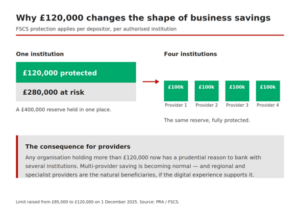
An organisation holding more than £120,000 now has a quantifiable reason to bank with more than one provider. This is basic prudence that a trustee board or auditor will increasingly expect to see evidenced. Charities should note an added wrinkle: FSCS eligibility turns on legal structure rather than charitable status, which is the sort of detail a volunteer treasurer may only discover when it matters.
That opportunity does not belong to the largest banks. A business with £400,000 to spread across four providers is unlikely to start with the institution that offered it 0.5 per cent in the first place. It is more likely to start with whoever makes the spreading easy.
An online application is no longer a differentiator
Regional building societies, credit unions and specialist banks tend to underestimate their position here. Business savings is a relationship product sold to people who are not financial professionals and who value being understood. A society that already banks the local businesses, sponsors the club and knows the charity’s chair by name has something the large banks have spent twenty years trying to manufacture.
The constraint has rarely been appetite or product, but digital delivery. For most of the past decade the bar was low: an online application that worked, a servicing portal that showed a balance and let you move money. Almost everyone has now cleared it, which means meeting the baseline stops you losing deals without ever winning them.
The real problem is not opening an account. It is the ongoing work of deciding how much cash can be committed, for how long, at what notice and across how many institutions, repeated every month, forever, by someone whose job title is not treasurer. Solving that means a single position across accounts rather than three balances to reconcile, rules the customer sets and the platform enforces, an experience that genuinely works on a phone, and analysis of what the organisation actually earned against what it could have.
The question is not what an agent can do, but who authorised it
Small organisations are beginning to run autonomous agents that carry out finance-function tasks, and those agents need somewhere to connect. The rails are further along than people assume. Sweeping variable recurring payments, mandated by the CMA, already permit a business current account as the source, so automated movement of surplus cash into a savings product is available infrastructure rather than speculation.
The regulatory position is unsettled, and any provider claiming otherwise should be treated with caution. In its Payments Regulatory Priorities report of March 2026, the FCA signalled it would review whether payments regulation needs to change for autonomous AI. Regulation 67 of the Payment Services Regulations 2017 requires the payer to consent to each transaction, a requirement written for a human deliberately clicking confirm.
That makes the governance layer more important than the intelligence layer. The questions that matter are under whose authority an agent moved money, within what limits, and whether the treasurer can produce an audit trail that satisfies a trustee board twelve months later.
This is where our development effort is going. Fintilect is building business savings capabilities for our platform roadmap, including MCP server capability allowing customer-side agents to interact with a provider’s savings products under bounded permissions, mobile applications designed for business savings rather than adapted from a consumer app, AI-assisted analysis of deposit history and projected returns, and customer-defined balance rules across a set of accounts. These are in development rather than in production, and we are looking for providers who want to shape them.
Five questions worth asking
If you run savings at a building society, credit union or specialist bank, these are the questions we would put to your digital provider.
- Can a business customer see their whole position with us on one screen, including maturity dates and FSCS headroom?
- Can they set their own access and balance rules, or must they ring us?
- Is our business savings experience genuinely usable on a phone, or is it a desktop product on a small screen?
- When a customer’s finance software wants to talk to us, what is the answer?
- If an agent moved money on a customer’s behalf, could we evidence the authority it acted under?
If the honest answer to most of those is no, that is simply where the market is today. It is also where the next three years of competitive advantage in business savings will be decided.
Where Fintilect fits
Fintilect designs, builds and fully manages digital banking experiences for UK financial services providers. We are the presentation and orchestration layer, the digital front door between an institution’s customers and its core systems. Business savings is one of our priority areas for 2026.
We are a small, specialist team rather than a large vendor. If the questions above are ones you are already asking internally, we would be glad to compare notes. Get in touch through the contact page at www.fintilect.com.
Sources: Bank of England Money and Credit, July 2026. FSCS and PRA, December 2025. SME deposit research published by a UK challenger bank, 2024, restated 2025.
Fintilect Limited is a technology provider and is not authorised or regulated by the Financial Conduct Authority. We operate under the regulatory permissions of our clients. Nothing in this article constit